Can a website be a work of art?
Yes, and it has been for about thirty years. This exploration looks at the difference between a website that shows art and one that is the work, at net art and its early history, at what artists do with the browser today, and at what it means for a work to have no opening hours, no wall and no fixed size.
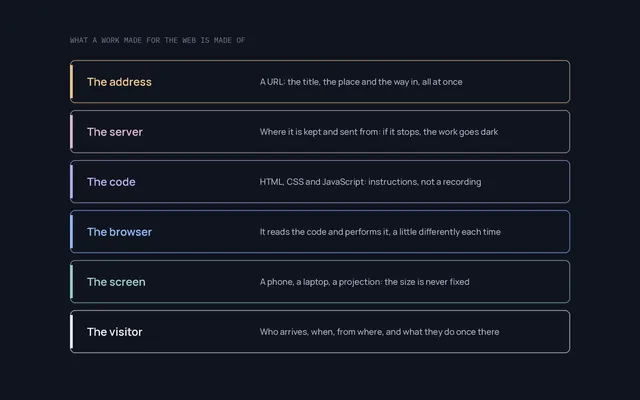
A website can be a work of art when the website itself is the work: when its code, its links, its behaviour in the browser and the act of visiting it are the material, rather than a way of showing something that exists elsewhere. A museum's online collection shows paintings; the paintings are on a wall somewhere. A work of net art has no wall. If you switch off its server, there is nothing left to see.
Showing art, or being it
Most websites that involve art are containers. An artist's portfolio, a gallery's shop or an archive of photographs points to objects that exist without the web. Take the page away and the works survive.
A web work reverses that. Its address is its title and its location. Its code is not a recording but a set of instructions that your browser performs each time you arrive, on whatever screen you happen to use. The way a page loads, breaks, scrolls or answers a click can be the point.
What net art is
Internet art, net art or web art are the usual names for art that uses the network as its medium, not merely as a way to distribute images. With a dot, net.art refers more narrowly to a loose group of artists in the mid-1990s, among them Vuk Ćosić, JODI, Alexei Shulgin, Heath Bunting and Olia Lialina, who worked with email, HTML and the early browser while they were still new and strange.
Their works were often made of the web's own parts: hyperlinks, frames, form fields, error messages, source code. They treated the browser not as a neutral window but as a material with habits that could be bent. For the history of the whole field, read What is net art?.
Early works that made the case
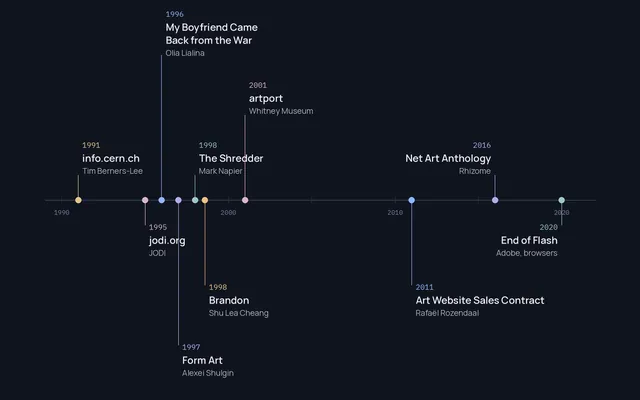
- jodi.org (from 1995). The Dutch-Belgian duo JODI, Joan Heemskerk and Dirk Paesmans, put up pages that looked broken: scrolling characters, flashing code, layouts that seemed to have collapsed. The error became the image.
- My Boyfriend Came Back from the War (1996). Olia Lialina told the story of a couple reunited after a war through black-and-white images and fragments of text. Each click splits the page into smaller frames, until the screen is a mosaic. Lialina called it a netfilm.
- Form Art (1997). Alexei Shulgin composed pages out of buttons, checkboxes and text fields, the grey furniture of web forms. Because every browser draws those elements differently, the work changes with the software that shows it.
- The Shredder (1998). Mark Napier made a page that poses as a browser: you give it an address, and it tears that page's code into an abstract composition of text and images.
- Brandon (1998–1999). Shu Lea Cheang's project about gender and violence, named after Brandon Teena, was the Guggenheim's first commission of a web-based work, and the museum later restored it.
Institutions followed. The Whitney Museum has commissioned web works for its artport since 2001, and between 2016 and 2019 Rhizome restaged a hundred works for its Net Art Anthology.
The browser as a creative medium
The browser is an odd material. You do not control the size of the canvas, the fonts installed, the speed of the connection or whether the visitor is on a train with a cracked phone. Web artists work with those uncertainties rather than against them.
Today the browser can also draw with the graphics card, play and analyse sound, and read a camera or a microphone when the visitor allows it. That makes possible works that are less like documents and more like instruments or places: pieces that run in real time and answer each visitor differently. The selection of interactive websites worth getting lost in gathers many of them, from playful toys to slow journeys.
Interaction, structure and participation
In a web work, structure is part of the meaning. A link is a decision; a page that splits when you click, as in Lialina's piece, turns navigation into editing. Participation can be minimal, simply arriving and scrolling, or it can shape the work, as in pieces whose content is made by the visitors themselves.
This is related to, but not the same as, the general question of what interactive art is, which the guide What is interactive art? covers through installations, museums and history. Here the focus is narrower: the web itself as the medium, with its addresses, browsers and screens.
Websites with no purpose
Most of the web is built to do something: sell, inform, measure, persuade. A web work is allowed to do none of those things. It can be a place to be for a minute, an experiment, a joke about the interface, or a question about what a page is.
That freedom does not rule out a market. The Dutch-Brazilian artist Rafaël Rozendaal makes websites, each one a single domain, and in 2011 he published the contract he uses to sell them: the collector owns the work, and it stays public at its address, with the owner's name shown in the browser's title bar. Ownership and free access coexist.
Synfield is one contemporary example of the same impulse: a set of worlds of light and sound that open at an address and run only while someone has them open. There are no goals or scores; what it offers is a place to experiment.
What changes when art lives at a URL
- Access. A URL has no opening hours and no ticket. The work can be reached from anywhere with a connection, by anyone who has the link.
- Context. There is no gallery to frame it. You arrive from a search, a message or another tab, often alone and in the middle of something else.
- Variability. Every visit is a performance on different hardware. The artist cannot fully know what you see.
- Fragility. Servers lapse, domains expire and technologies disappear: browsers dropped Flash at the end of 2020, taking a generation of web works with it. Preservation tools such as Rhizome's oldweb.today, which opens pages in emulated old browsers, exist because of this.
So, can a website be art?
Yes, when the website is the work and not its frame. What makes it art is not the technology but the intention and the attention it asks for: a page made to be experienced rather than used. The most useful question to ask of any site is therefore not whether it looks artistic, but what remains when you take the website away.