When sound becomes shape: what is cymatics?
Cymatics is the study and practice of making vibration visible, usually by letting sand, powder or liquid show how a surface moves. This exploration explains how the patterns form, without any physics background, tells the story of Chladni's figures, separates the physical phenomenon from its artistic versions, and shows how a digital world can interpret the idea.
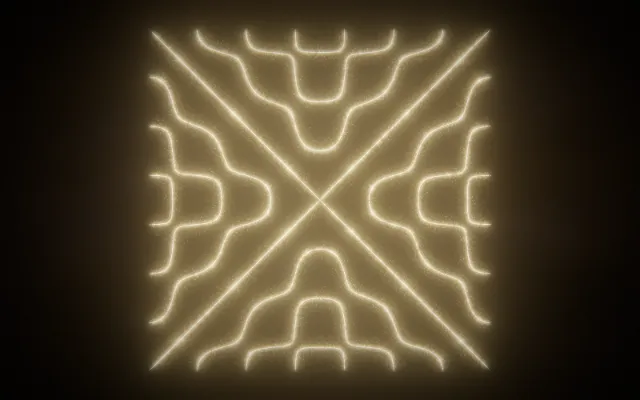
Cymatics is the practice of making vibration visible. When a plate, a skin or a liquid vibrates at certain frequencies, some parts move a lot and some barely move at all, and a fine material spread on top, such as sand, gathers into a pattern that shows where those quiet places are. The patterns are often called Chladni figures, after the scientist who studied them systematically more than two centuries ago.
Why sand draws a figure
Imagine a thin metal plate held at its centre, with a little sand on it. Draw a violin bow along its edge and the plate begins to vibrate. At most pitches the sand just trembles. At certain pitches, though, the plate settles into a steady way of vibrating, called a mode, and the sand suddenly moves.
In a mode, the plate is divided into regions that move up and down in opposite directions. Between those regions run lines that hardly move at all: the nodal lines. Where the plate moves strongly, at the antinodes, grains are thrown into the air and land somewhere else. When they happen to land on a nodal line, nothing throws them again. After a few seconds, almost all the sand has collected on the lines, and the figure appears.
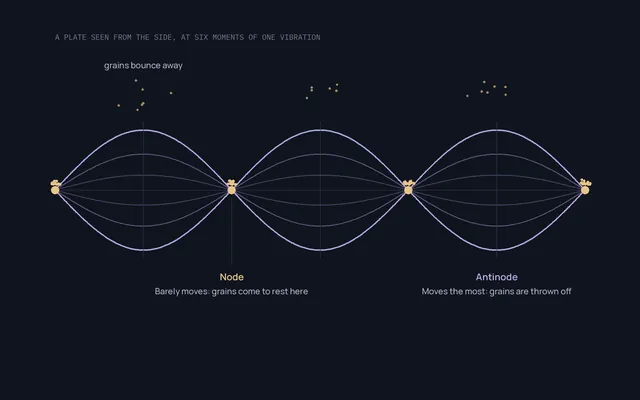
So the figure is not a picture of the sound in the air. It is a map of how one particular plate moves at one particular frequency.
Chladni's figures and their history
The effect was noticed before it was explained. On 8 July 1680 Robert Hooke ran a bow along the edge of a glass plate covered in flour and saw nodal patterns form. A century later, the German physicist and musician Ernst Chladni made the method systematic. In his 1787 book Entdeckungen über die Theorie des Klanges (Discoveries in the Theory of Sound) he described metal plates sprinkled with sand and bowed at the edge, and drew dozens of the figures they produced.
Chladni demonstrated the figures in Paris in 1808, before an audience that included Napoleon, who had a prize set up for a mathematical theory of vibrating plates. The mathematician Sophie Germain was the only entrant in its first two rounds, and on her third attempt she was awarded the prize, although her theory still had gaps that later mathematicians would close.
A detail from 1831 shows how subtle the effect is. In his paper On a peculiar class of acoustical figures, Michael Faraday noted that very light powders, such as lycopodium spores, collect at the parts of the plate that vibrate most, the opposite of sand. He traced the difference to the air currents set up by the vibrating plate, which carry very light particles but not heavier sand grains.
The word cymatics, from the Greek kyma, wave, came much later. The Swiss physician Hans Jenny coined it for his book Kymatik (1967), a photographic study of sand, powders and liquids set in motion by oscillators.
What changes the pattern
Three things decide which figure you see.
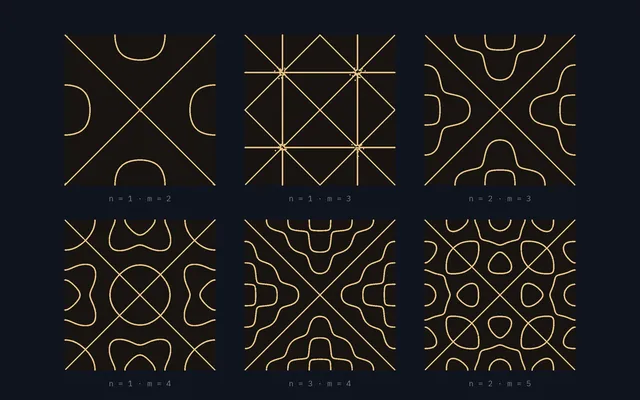
- Frequency. A plate can vibrate in many modes, each at its own frequency. Higher modes usually divide the plate into more regions, so the figures become more intricate.
- The material and the object. Size, thickness, shape, stiffness and density all change which frequencies the plate prefers. A square plate and a round one tuned to the same note do not make the same figure, and neither do steel and glass.
- Resonance and how it is held. A pattern appears clearly only near a resonant frequency, when the plate responds strongly to the push it receives. Where the plate is fixed and where it is excited also matter: clamping it at the centre or at an edge changes which modes can occur.
Sound, geometry and perception
The figures are striking because they are symmetrical, and the symmetry has a plain cause: a symmetrical plate vibrates in symmetrical ways. Their geometry belongs to the object as much as to the sound.
That plainness matters, because cymatic images are often used to support claims that sound has healing shapes, or that certain frequencies are special in themselves. The physics does not support such claims. Chladni figures are well explained by the classical mechanics of vibrating surfaces. What is real, and remarkable, is how directly they let our eyes see something we normally only hear.
Artistic interpretations
Artists have used cymatics in two different ways: by staging the real phenomenon, and by borrowing its look.
The composer Nigel Stanford's music video Cymatics (2014) is an example of the first. Each sound triggers a physical experiment, a Chladni plate, a speaker dish of water, ferrofluid, and the project states that all of the experiments are real. Many visual artists take the second route, drawing on the symmetry and order of the figures without any plate.
Digital artists sit between the two. They can solve the equations of a vibrating plate, approximate them, or simply use the figures as a visual language. Each is legitimate, as long as the work does not pretend to be the other.
Cymatics in Synfield: an interpretation
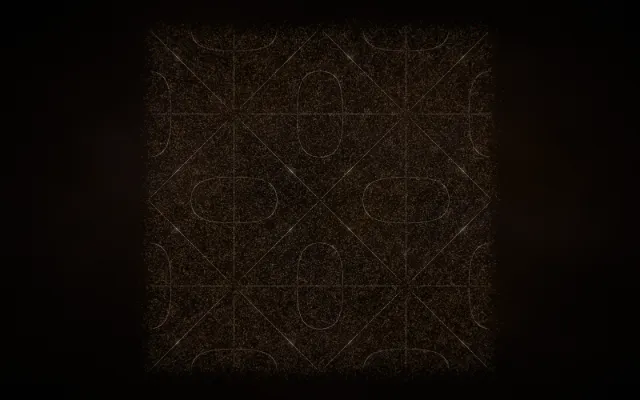
Cymatics in Synfield is an artistic interpretation, not an experiment. There is no plate and no vibration. The world draws tens of thousands of grains of light and moves each one, every frame, toward the nearest line where a well-known simplified formula for the figures of a square plate is zero. The formula produces patterns very like a real plate's, but it is not a simulation of one, and no physics decides where a grain lands.
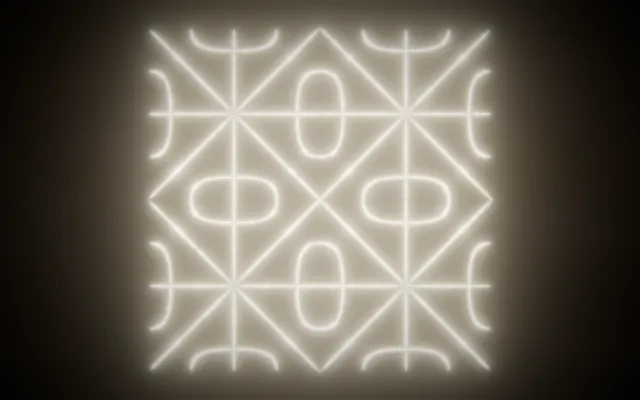
The world offers nine figures. Opening or closing the hand, or turning the mouse wheel, moves between them, from the simplest to the most intricate, and each figure is paired with a note of a pentatonic scale in the world's sound. That link between note and figure is a design choice: the sound you hear does not shape the pattern, as it would on a physical plate. Holding a pinch, or pressing and holding, freezes the figure; letting go throws the grains off before they find their lines again.
In short
Cymatics makes vibration visible: grains collect where a vibrating surface stays still, and the resulting figure depends on frequency, material and the way the object is held. It has a long history, from Hooke and Chladni to Jenny, and a long life in art. When you meet a cymatic image, it is worth asking which kind it is: a real surface vibrating, or a picture that borrows its order. Both can be beautiful, and they are not the same thing. For the wider family of works that answer what you do, see What is interactive art?.