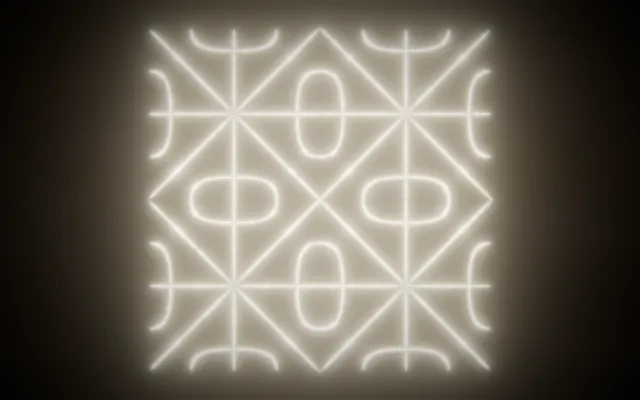
Seeing a sound in sand
In real cymatics, sound vibrates a plate and sand gathers where the surface moves least, tracing a pattern.
Cymatics in Synfield takes that idea into an interactive world: grains of golden light gather along the lines of a virtual plate. It is an artistic interpretation, drawn in your browser.
Tune, hold, scatter
On its own, the plate moves between patterns.
Move across it to shift the figure. Open or close your hand to tune a different pattern, or use the wheel or two fingers.
Hold and the figure freezes while the grains settle into its lines. Release and they jump, then gather again.
If you turn sound on, each pattern has its own note.
Where it comes from
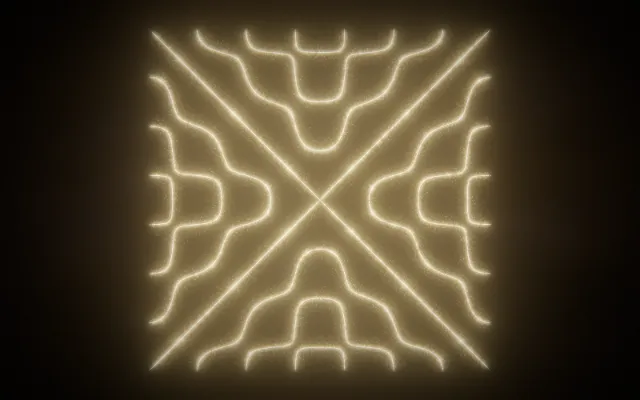
Cymatics is the study and visualisation of patterns produced by vibration.
One of its best-known demonstrations involves scattering sand across a vibrating metal plate. At certain frequencies, the grains gather along areas of minimal movement, called nodal lines, forming intricate geometric figures known as Chladni patterns.
The shapes change according to the plate, its boundaries and the frequencies that excite it. Cymatics takes inspiration from this meeting between sound, motion and visible geometry.
Its grains of light suggest a surface in which vibration can organise matter into patterns, turning something normally heard into something that can also be seen.
Things to try
- Start with a gentle disturbance and watch the grains arrange themselves.
- Change the vibration and look for a new pattern.
- Follow the lines where particles begin to gather.
- Wait for one figure to settle before shaping another.
With a mouse, touch or your hands
You can explore with a mouse, a touch screen or your own hands.
Mouse and keyboard
- Move the pointer to shift the pattern.
- The wheel, or the up and down arrows, tunes the plate.
- Hold the button to freeze the figure, then release to scatter the grains.
Touch
- Slide a finger to shift the pattern.
- Separate or bring two fingers together to tune the plate.
- Rest a finger to freeze the figure, then lift it and the grains jump.
Hands, with the camera
- Point to shift the pattern.
- Open or close your palm to tune the plate.
- Hold a pinch to freeze the figure, then release it to scatter the grains.
- The camera stays off until you turn it on.