What is a particle system in digital art?
Smoke, sparks, swarms, clouds of light: much of the motion in digital art is made of particles. This exploration explains what a particle system is, how its rules work, why simple parts add up to complex images, and how it differs from a physics simulation or a generative system, with real frames from Matter, Nebula and Vortex.
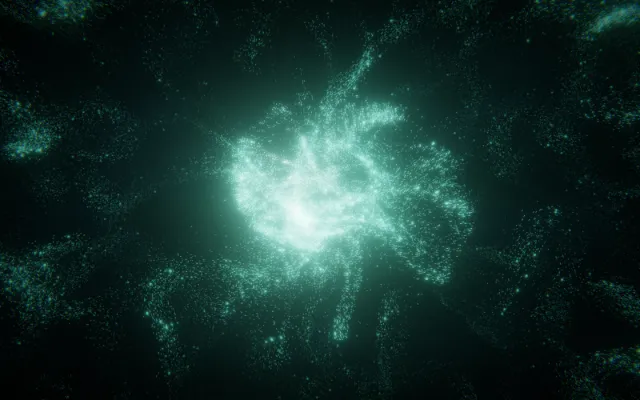
A particle system is a way of drawing something as a large number of small elements, the particles, each moved by the same simple rules. No single particle looks like much: a point with a position, a speed and perhaps a colour or an age. Together, thousands of them can read as smoke, a flock, a cloud of gas or a field of light that swerves around your hand.
Where the idea comes from
The term comes from computer graphics. In 1983 William T. Reeves, then at Lucasfilm, published Particle Systems: A Technique for Modeling a Class of Fuzzy Objects, describing the method behind the fire that spreads across a planet in the "Genesis effect" of Star Trek II: The Wrath of Khan (1982). His argument was simple: fire, clouds or water have no fixed surface to model, so it is easier to describe how many tiny things are born, move, change and die.
Artists took the idea up quickly. Karl Sims's animation Particle Dreams (1988) applied behaviour rules to thousands of particles to make a snowstorm, a waterfall and a restless head. Today the same principle runs in game engines, visual effects software and creative-coding libraries, and in the browser, on the graphics card of an ordinary phone.
What a particle is, and what moves it
In most systems a particle is a short record of numbers: where it is, how fast and in which direction it travels (its velocity), and sometimes its age, mass or colour. The system repeats one loop many times per second, for every particle:
- Add up the forces acting where the particle is.
- Change its velocity a little in that direction.
- Move it by its velocity.
- Draw it.
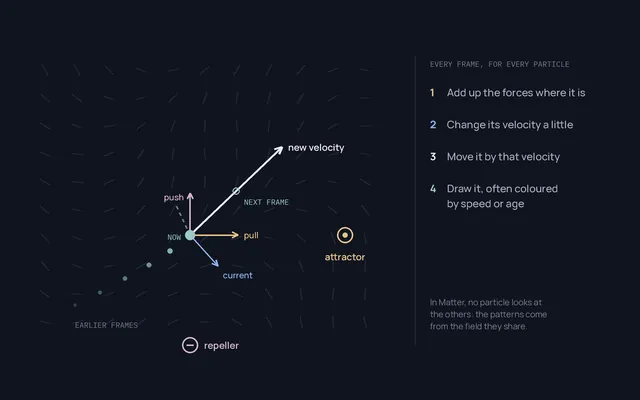
Almost everything interesting happens in the first step. A force is any rule that says "push this way, here". Attraction pulls particles toward a point and repulsion pushes them away, usually less strongly the farther they are. A flow field gives every place a direction, like a current in water. Damping takes a little speed away each frame so nothing runs off forever. Many systems also have emitters, which create new particles, and a lifespan after which each one fades.
Velocity is what makes the result feel physical. A particle does not jump to where a force points: it turns toward it over several frames, overshoots and curves. That inertia is why a field of particles seems to have weight.
How simple parts make complex images
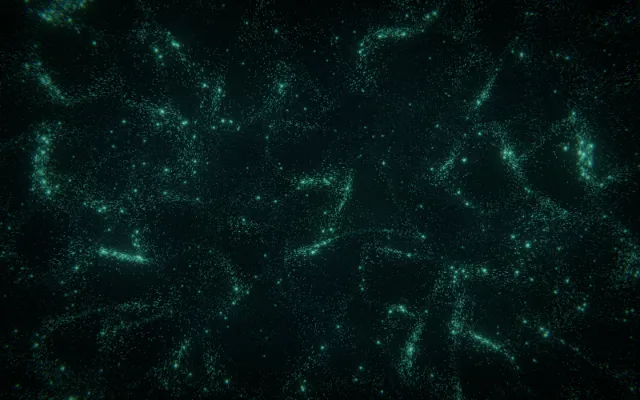
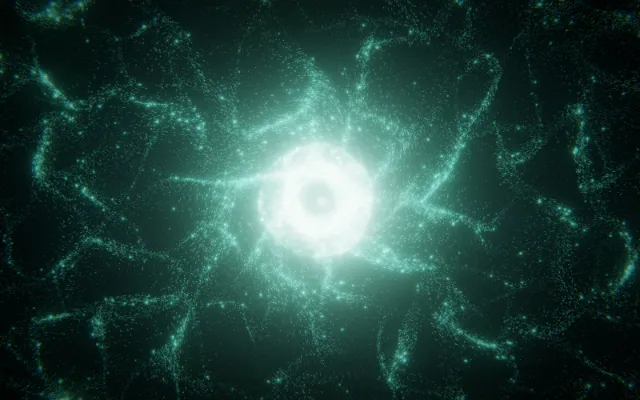
Each rule fits in a line or two, yet the image they produce is rarely predictable. The two frames below come from a small system written for this story: 6,000 particles scattered at random, each reading the same smooth current and easing its velocity toward it. No particle knows that any other exists.
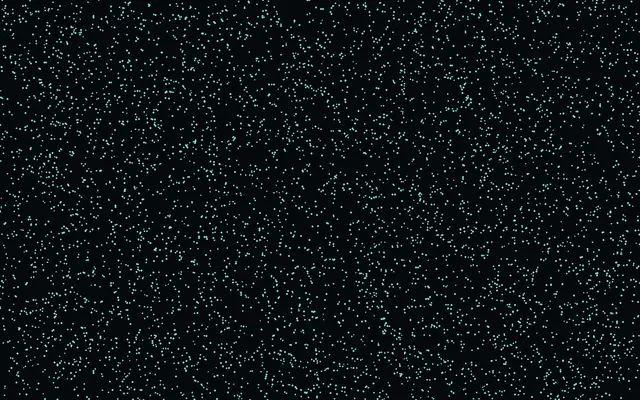
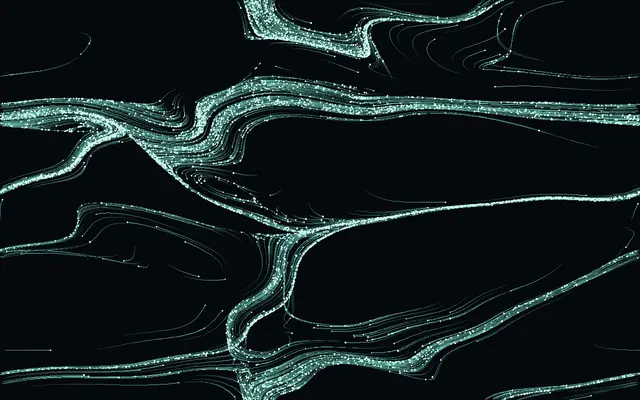
After a few seconds the scatter has organised itself into lanes, eddies and empty pools. Nobody drew those lanes; they appear because thousands of particles follow the same field and collect where its currents converge. This is what emergence means: structure at the scale of the whole that no rule describes at the scale of the part. The guide to interactive generative art follows the same idea through the Game of Life and flocking boids, systems in which the agents do react to each other.
Three worlds, three techniques
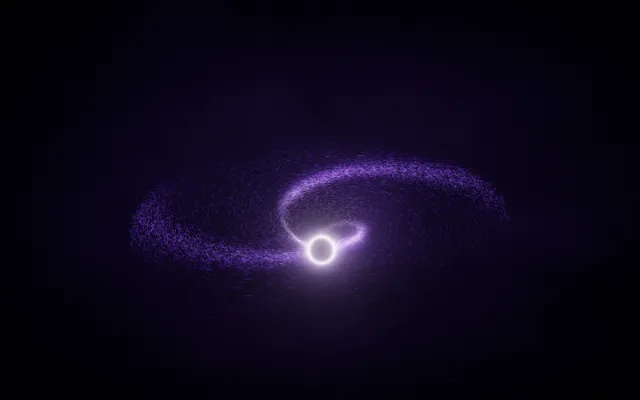
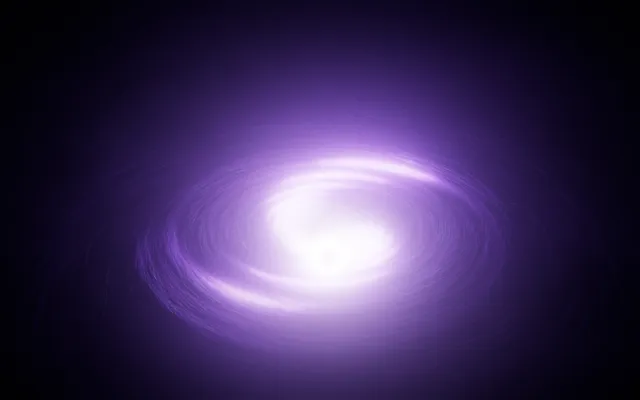
It is tempting to assume that every particle image is a physics simulation. Synfield's three particle worlds show that it is not, and the difference is visible once you know where to look.
Matter: a simulation
Matter is a particle system in the classic sense. Up to about 65,000 particles keep their position and velocity from one frame to the next, stored on the graphics card and updated every frame. Each is carried by a current computed as the curl of a noise field, a technique set out by Robert Bridson and colleagues in Curl-Noise for Procedural Fluid Flow (2007) that swirls without piling particles up, plus a small extra term that gathers them into filaments. On top of that come your forces: a mouse pointer pulls and stirs, the code reads an open palm in front of the camera as a push, a held pinch digs a gravity well, and letting go sends out a wave.
Nebula: calculated, not simulated
Nebula has up to 52,000 points, but none of them remembers where it was. Each has a fixed home in a cloud generated when the world opens. Every frame, the graphics card works out where each point should appear from that home, the time, how open the hand is, where the pointer is and any shockwave in progress. Closing the hand pulls the inner layers in first and the outer ones later, because the two follow different springs.
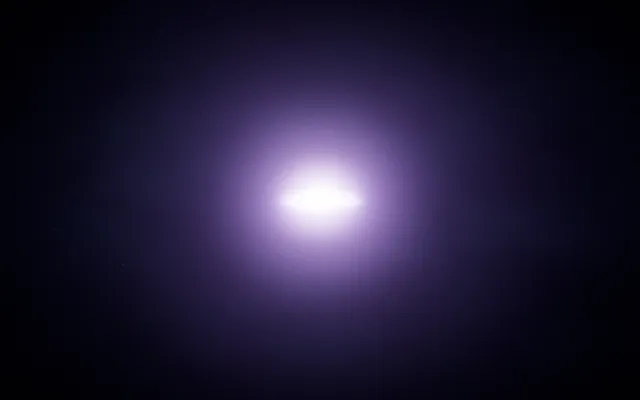
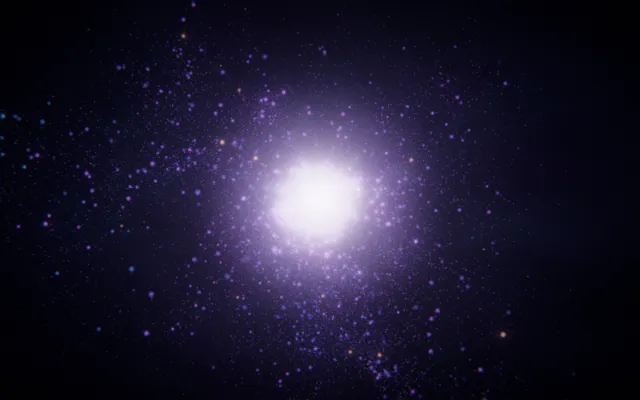
The cloud moves like a fluid but is closer to animation driven by rules. Because nothing accumulates from frame to frame, it always finds its shape again.
Vortex: one quantity with memory
Vortex draws tens of thousands of short streaks around a dark core. Their positions are calculated too: each streak has its own orbit and turns with a shared rotation that runs faster near the centre, so the disc shears. What has memory is a single number, the spin. Drawing circles while you hold the vortex adds to it; once you let go, friction takes it away slowly.
Particles, physics and generative systems
The three terms overlap, but they are not synonyms.
| Term | What it is | Example |
|---|---|---|
| Particle system | A way of representing something as many small elements moved by rules | Sparks and smoke in a film, Matter, Nebula |
| Physics simulation | A model that follows physical laws closely and is checked against measurements | Airflow over a wing, a crash test |
| Generative system | A process of rules, often with chance, that produces the work with some autonomy | The Game of Life, a plotter drawing |
A particle system can be part of a physics simulation, as when engineers track droplets in a spray. In art, though, the forces are usually chosen because they look and feel right, not because they are correct: Matter's currents are not real air or water. That is why most particle art is also generative art. The artist designs the rules, and the system produces images nobody drew one by one.
Why particles suit interactive art
Particles answer a person well because each one responds locally. A hand or a pointer is just one more force in the same sum as the current, so the system does not need to understand a gesture to respond to it. The response is continuous rather than a switch, and because the particles have inertia, a movement leaves a wake that lasts a few seconds after you stop. That is close to the loop of acting and being answered described in What is interactive art?.
To build one yourself, the free online book The Nature of Code by Daniel Shiffman has a clear chapter on particle systems, and Craig Reynolds's page on boids shows what happens when particles begin to steer by their neighbours.
In short
A particle system is many simple elements, one loop and a set of forces. The forces give the image its character: currents give drift, attraction and repulsion give a response to a point, inertia gives weight. Not every particle image is a simulation, either. Some are recalculated from scratch every frame, and some keep only one quantity with memory. Noticing those choices is a useful way to read any work made of particles.