Mycelium in digital art: networks that grow towards you
Under every mushroom lies a network of fine threads that most of us never see. This essay looks at what that network is, at the wood wide web and the debate around it, at a slime mould that drew a railway map and the simulations it inspired, and at the artists who grow work from mycelium itself. It ends with a network of light that grows towards you.
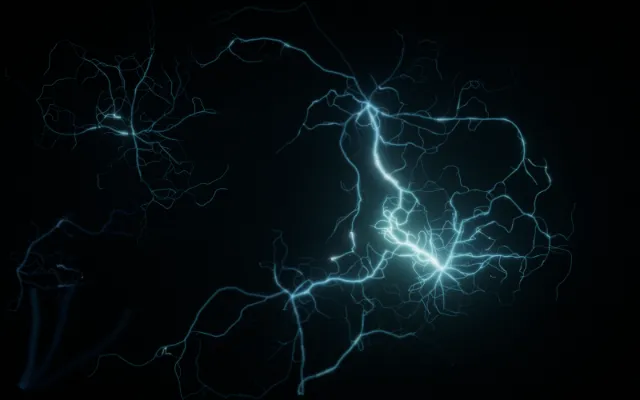
Most of a fungus is invisible. What we call a mushroom is a brief appearance above ground; the rest of the organism is a mesh of threads running through soil, wood and leaf litter. In the last two decades that hidden mesh has moved from field guides into galleries, design museums and code. Mycelium art now covers bricks grown in moulds, installations wired to living cultures and simulations of branching light.
This essay asks why. Part of the answer is the shape itself: a network with no centre, which grows slowly, follows what feeds it and keeps a trace of where it has been. Part of it is a metaphor, the wood wide web, that turned out to be more popular than the evidence behind it. And part of it is a slime mould, which is not a fungus at all, that taught programmers how to grow networks of their own. If you want a sibling essay about another natural phenomenon that feels at home on a screen, Moiré patterns: the art of interference is a good companion.
What mycelium actually is
The botanists at Kew put it simply in their guide to the hidden dimension of fungi. You might have seen mycelium as a fuzzy mass on mouldy food, they write, but "out in the wild, mycelium is more than just the sign of an out-of-date sandwich: it's a whole network of thin fungal strands called hyphae." Those hyphae "explore the soil or any other substrate where fungi are growing" and secrete enzymes onto their food, breaking down dead matter that then feeds the fungus, its plant partners and many other organisms.
A few details from the same page explain why artists find the structure so suggestive. Most mycelial networks are microscopic, but some grow very large: an Armillaria ostoyae under a national forest in Oregon is estimated to cover almost ten square kilometres. The mycelia of two compatible fungi can fuse. And through their mycelium, many fungi partner with plant roots in what Kew calls "a cross-kingdom web known as mycorrhizal (meaning 'fungus-root') networks": plants pass sugars and fats to the fungi, and the fungi help the plants reach water and nutrients beyond their own roots.
Merlin Sheldrake made this world familiar to many readers with Entangled Life, published in 2020. Its opening idea is the same one: "mushrooms are only fruiting bodies, analogous to apples on a tree. Most fungi live out of sight."
The wood wide web, and how far it goes
The image that made mycelium famous comes from forests. In August 1997, Suzanne Simard and her colleagues published a field study in Nature on carbon moving between two tree species, paper birch and Douglas fir, through the fungi that colonise both of their roots. Using isotope labels, they found that carbon travelled in both directions and that the fir came out with a small net gain, which depended on how much shade it was in.
The paper itself never says "wood wide web". As a 2024 editorial in Nature Plants explains, those words were on the cover of that issue of Nature, "but no one can remember which member of staff came up with them." The phrase stuck because, in the editorial's words, "the metaphor of a wood-wide-web is almost too good": it suggests fungal threads acting like the cables of the internet, and a forest that shares food and warnings like a single organism.
That is where the science becomes contested, and it is worth being fair about it. In 2023, the ecologists Justine Karst, Melanie Jones and Jason Hoeksema published a Perspective in Nature Ecology & Evolution that looked at three popular claims about these common mycorrhizal networks. They concluded that the claims that such networks are widespread in forests, and that resources moving through them help seedlings grow, "are insufficiently supported", and that the claim that mature trees preferentially send resources and defence signals to their offspring "has no peer-reviewed, published evidence." They also found that unsupported claims in citations of this research had doubled over 25 years. The Nature Plants editorial adds that this view is "shared by many in the ecology community", while noting how hard these experiments are to do well.
So the shared thread underground is real, and carbon can cross it. A forest-wide internet of caring trees is, for now, a metaphor running ahead of the evidence. For art, that distinction matters less than it does for forestry, but it is a good reason to treat the network as an image, not as a proof.
A network that is not a fungus
The second strand of this story is a creature often confused with fungi. Physarum polycephalum, the many-headed slime mould, looks like a fungus and is often studied by mycologists, but it is not one. National Museum Wales notes in its page on slime moulds that they are "not part of the Kingdom Fungi" and are classified as protists, "distantly related to microscopic single-celled Amoebas." Utah State University's herbarium adds that Physarum's yellow body is a huge single cell containing many nuclei.
In 2010 Atsushi Tero and his colleagues published a study in Science titled Rules for Biologically Inspired Adaptive Network Design. They placed food at points matching the cities around Tokyo and let Physarum grow from the point that stood for the capital. The abstract states the result plainly: the slime mould "forms networks with comparable efficiency, fault tolerance, and cost to those of real-world infrastructure networks—in this case, the Tokyo rail system." The team then captured the core of that behaviour in a mathematical model.
The science writer Ed Yong described how it happens in a 2010 article for National Geographic. The mould first filled the space with a dense web, then "thinned out its networks to focus on branches that connected the food sources." In Tero's model, he explains, the faster the flow through a tube, "the wider the tube becomes. If the flow slows, the tubes thin and eventually disappear." Use strengthens a route; neglect lets it go. That is the closest thing to memory a network without a brain can have: its shape is a record of where food was found.
From slime mould to code
That same year, the researcher Jeff Jones published a different way of approximating Physarum in the journal Artificial Life. His paper, Characteristics of pattern formation and evolution in approximations of Physarum transport networks, used "a population of simple particle-like agents". Each agent follows a chemical trail and leaves more of it behind, and from these "simple local behaviors" the population "spontaneously forms complex and dynamic transport networks", which contract, branch and even repair themselves.
The model was simple enough to travel well beyond biology. In February 2019 the artist Sage Jenson wrote up their own Physarum simulations, built on Jones's paper and running on a graphics card with millions of particles. Jenson describes the two layers at the heart of the model: particles that sense a trail map through three sensors, and a trail map that spreads and fades a little every step. They also explain that they set aside one of Jones's rules because they preferred the patterns that arose without it, which is a very generative-art decision: the model is faithful enough to produce living-looking networks, and free enough to be tuned for beauty.
This is the lineage that Interactive generative art, explained traces more broadly: a few local rules, many repetitions, and a form that nobody drew. Physarum simulations, flocking and particle systems all belong to it, and What is a particle system in digital art? explains the particle side in more detail.
Mycelium art: growing the work itself
While programmers simulated networks, other artists began to grow with mycelium directly. The artist Phil Ross, according to the biography of Open Fung, a project he co-founded, began cultivating mycelium "as a material for art and design in the 1990s", working with the reishi fungus, and coined the word mycotecture in 2008 "to describe the art of designing and building with mycelium." His mycelium works have been shown at MoMA, the Kunsthalle Düsseldorf and the Moscow Biennale.
In 2014 the studio The Living, led by David Benjamin, won the Young Architects Program at MoMA and MoMA PS1 with Hy-Fi, a temporary tower for the museum's courtyard. The museum's announcement describes organic bricks made from corn stalks and "specially-developed living root structures", a process invented by the company Ecovative; its curator Pedro Gadanho noted that the structure presented itself "as being 100% compostable." One of those mycelium bricks is now in MoMA's collection, where the label explains that the bricks are left in moulds "to biologically cement through fungal growth."
Other mycelium artworks treat the network as a partner rather than a material. In Myconnect (2013), by Saša Spačal with Mirjan Švagelj and Anil Podgornik, a visitor enters a capsule where their heartbeat is routed through living mycelium. In the artists' description, the mycelium's "oscillations of electrical resistance" shift the incoming heartbeat, which returns to the body as sound, light and vibration. The piece received an Honorary Mention at Ars Electronica in 2015.
Across these works the same qualities return. A mycelium is a network rather than an object, so it suggests connection without a centre. It grows slowly, so it asks for patience. It responds to what feeds it, so it can respond to a visitor. And its shape records its history. Those are also the qualities that make it a natural subject for interactive art, where a work is only complete when someone takes part.
A living network in the browser
Synfield's Mycelium world takes these ideas into a browser tab. Its official description is one line: "A living network that grows towards you and remembers."
What you do is simple. Move the pointer or a finger, and the filaments sense you and slowly grow towards where you are. Hold the mouse button, or keep a finger still for a moment, and you feed the network: the flow brightens and runs along its routes. Release, and the glow lingers on the routes it took, then slowly fades. The wheel, or spreading and closing two fingers, changes nothing here, because the network answers only your presence. If you choose hands mode, the world only shows instructions; it never turns on the camera.
Underneath, the network is a branching tree of filaments. Its growing tips drift slowly, curving as they search, and they sense food imperfectly: the richer the food, the better they find it. In this world, the food is you. Staying still makes your presence richer, so new branches sprout and fuse with the network. Flow runs from the food back to the roots and lights up those routes, which is why holding brightens the paths that lead to you.
"Remembers" is meant literally, but only for a while. Filaments that carried the flow stay wider and brighter for a short time, then fade; parts of the network that nothing uses fade away completely. It is close in spirit to the tubes in Tero's model, which widen with flow and thin without it, and to the trails in Jones's agents, which spread and decay. But it is a different system: a growing tree of filaments, not a slime mould simulation. The network is silent, too, so what you notice is light and growth.
Some things worth trying on a first visit:
- Arrive and wait. The tips need time to turn towards you; the growth is slow by design.
- Stay still. A resting pointer or finger enriches the food, and new branches appear around you.
- Hold, then let go. Watch the flow run along the routes that reach you, and the glow stay on them after you release.
- Move somewhere else. The old routes fade, and the network starts to reach for your new position.
Mycelium art keeps coming back to the same small set of ideas: a network instead of an object, growth instead of a fixed form, and a shape that remembers what fed it. In a forest those ideas are still being tested. In a browser they can be felt directly: a network that grows towards you, remembers you for a while and lets you go. You can enter Mycelium and feed it yourself.