What makes a website immersive? Presence, sound and a slower pace
Immersive is one of the most used words in web design, and one of the least defined. This essay goes back to where the word comes from, a plunge into water, and to what researchers have said about feeling present somewhere that is not real. It looks at what browser makers mean by the immersive web, at scrolling stories built to absorb the reader, and at five qualities that make a website feel like a place, and ends with a world you can enter.
Search for immersive websites and you will find a familiar mix: portfolios built as 3D islands, product pages that unfold as you scroll, virtual tours, galleries of award winners. The word is used for almost anything that moves, fills the screen or takes a long time to load. It is rarely explained.
Yet the word has a precise origin, and it says more about what a good web experience can be than most of the examples it is attached to. This essay starts there and ends with a world you can enter in Synfield. If you are looking for a list of sites to explore, Cool interactive websites worth getting lost in gathers sixteen of them. Here the question is different: what actually makes a website immersive?
A word borrowed from water
In 1997 the scholar Janet Murray published Hamlet on the Holodeck: The Future of Narrative in Cyberspace, a frequently cited book in which she explained where the word comes from. "Immersion is a metaphorical term derived from the physical experience of being submerged in water," she wrote, in a passage quoted in a 2016 review of definitions of immersion by Niels Christian Nilsson, Rolf Nordahl and Stefania Serafin. "We seek the same feeling from a psychologically immersive experience that we do from a plunge in the ocean or swimming pool: the sensation of being surrounded by a completely other reality, as different as water is from air, that takes over all of our attention, our whole perceptual apparatus."
The passage continues, as quoted in a 2020 paper by B. K. Szabó and A. Gilányi on the term in virtual reality research. Murray describes "the delight that comes from learning to move within it", and then makes a distinction that matters for anything interactive: "Immersion can entail a mere flooding of the mind with sensation (...) But in a participatory medium, immersion implies learning to swim, to do the things that the new environment makes possible."
Those two halves describe two very different kinds of website. One floods you: full-screen video, sound that starts on its own, effects at every turn. The other lets you learn to swim.
Nilsson and his co-authors also show why the word stays slippery. Some researchers treat immersion as a property of the technology, a measure of how much of your senses a system surrounds. Others treat it as a response: to a story, to a world, to a challenge that asks for your skill. "To use Murray's water metaphor," they write, "some believe immersion to be an expression of how deeply one is submerged into a body of fluid, while others believe it to be the subjective experience of being submerged."
Being there, and believing it
The virtual reality researcher Mel Slater drew the split more sharply. In a 2009 paper in Philosophical Transactions of the Royal Society B, he separated three ideas that are often mixed up.
Immersion, for Slater, belongs to the system. It is defined by what he calls valid actions: the things you can do, such as turning your head, that change what you perceive or change the world in front of you. A headset that follows your head is more immersive, in this sense, than a screen on a desk.
The second idea is place illusion, "the qualia of having a sensation of being in a real place", what most people call presence or "being there". Slater is frank that an ordinary screen struggles here. He asks whether you can feel you are there with a desktop system and answers that, by his definition, "you cannot", although people can still report the feeling when they add some "mental recreation" of their own.
The third idea is the most useful for the web. Slater calls it plausibility illusion: "the illusion that what is apparently happening is really happening (even though you know for sure that it is not)." It does not depend on how realistic a scene looks. "It is important to realize that Psi does not require physical realism," he writes, using his shorthand for it. What it needs, based on many experiments, is that "events in the virtual environment over which you have no direct control refer directly to you."
A browser window will never surround you the way a headset can. But a page can do something that has little to do with resolution or 3D: it can notice you, and answer in a way that is about you.
What browser makers call the immersive web
There is also a strict, technical meaning. The World Wide Web Consortium, which sets web standards, has an Immersive Web Working Group whose stated mission is to "help bring high-performance Virtual Reality (VR) and Augmented Reality (AR) (collectively known as XR) to the open Web". Its main standard, the WebXR Device API, names the difference plainly. A session can be "inline", meaning its output "will be shown as an element in the HTML document", or "immersive-vr", meaning it "will be given exclusive access to the immersive XR device display". MDN describes the devices involved, from "fully-immersive 3D headsets" to phones that add computer-generated images to the camera's view.
So, in the vocabulary of browser makers, an immersive web experience is one that takes over a headset. That is not what most people have in mind when they search for immersive websites on a laptop or a phone.
Scrolling into a story
In December 2012 The New York Times published Snow Fall: The Avalanche at Tunnel Creek, John Branch's account of skiers and snowboarders trapped beneath an avalanche in Washington State's Cascade Mountains. Text, photographs, video and interactive graphics were woven into a single long page.
The paper's graphics director, Steve Duenes, explained the goal to Poynter the day it came out: to "find ways to allow readers to read into, and then through multimedia, and then out of multimedia. So it didn't feel like you were taking a detour." He used a word close to Murray's: "The experience sort of absorbs you."
There, the effects served the story. It is easy to keep the effects and lose the reason for them: backgrounds sliding at different speeds, text flying in from the sides, the scroll wheel taken over to drive an animation. Accessibility guidance has a word of caution here. The W3C's explanation of the success criterion Animation from Interactions points out that "some users experience distraction or nausea from animated content", and names parallax scrolling as an animation that is often non-essential. A page that makes some of its visitors dizzy is not surrounding them with anything. It is pushing them out.
What makes a website immersive
If immersion is less about how much of your senses a page covers and more about whether it answers you, a few qualities follow. None of them requires a headset or a 3D engine.
It answers your body, not only your clicks. Slater's plausibility illusion rests on events that refer to you. On a web page, the most direct version of this is a world that responds to how you move: the speed of a gesture, where your hand rests, whether you hold or let go. Artists explored this long before webcams, a history told in Your body as the interface. In a browser, a pointer, a fingertip or, if you choose to turn on a camera, a hand can be enough. The art collective teamLab invites visitors to its Borderless museum in Tokyo to "immerse your body in borderless art", in a world of works that, in its own words, "have the same concept of time as the human body". A website cannot fill a room, but it can listen to a body in a similar way.
It sounds, when you want it to. Sound reaches you from outside the frame, which is also why sound that starts by itself is a quick way to make someone close a tab. On Synfield's home page, under the heading "Sound, if you want it", the promise is "a little more immersion, only when you choose." Synfield begins in silence, and when sound is turned on, it is generated in the browser and shaped by what you do.
It keeps a slow rhythm of its own. Places feel real when they go on without you. Orb.Farm, by the designer Max Bittker, describes itself as "a virtual aquatic ecosystem". In 2020, The Verge called it "an entire little world in a glass jar in your web browser", where "the simulated days and nights pass" and the creatures "live as long as you keep your oxygen levels balanced, hanging out in a spare browser tab." Nothing in that description is fast. Its pull comes from time passing, not from effects arriving.
There is nothing to fill in. You cannot be absorbed by a page that keeps tapping you on the shoulder. A sign-up wall, a pop-up asking for your email, a progress bar to complete: each one is a reminder that you are using a product, not standing somewhere. Synfield's front page asks for nothing of that kind: "Nothing to install. No sign-up. Camera optional." The essay A website that asks nothing of you explores why that absence can be worth something.
It lets you dial it down. This may sound like the opposite of immersion, but it is part of it. MDN explains that the prefers-reduced-motion setting lets a person tell the browser they prefer an interface "that removes, reduces, or replaces motion-based animations". A place you can make quieter is a place more people can stay in. Synfield's home page says that if a device asks for reduced motion, "the light here starts still", and its guide lists settings for light, glow, trails, reduced motion, pausing idle movement and volume.
Put together, these qualities describe something closer to Murray's swimmer than to a showreel.
Presence without a headset: Helix
Synfield is a set of worlds of light, matter and sound that respond as you move. They are drawn in real time in the browser, with nothing to install and no account. Two of them show the ideas above especially clearly.
Helix is "a tide of light that winds and answers your presence." Its page describes "a luminous structure" winding through space, with lines and points of light that follow curved paths, "turning towards you before disappearing behind other layers." It keeps turning on its own. "Your presence changes the way the light winds and gathers," the page says, "allowing you to influence its shape without bringing the movement to a complete stop."
That last phrase is close to what Slater describes: a world that goes on by itself, yet keeps referring to you. Moving the pointer, a finger or your index finger winds the current. Holding draws it in and breaks it into spray; letting go lets a wave of light form it again. The wheel, two fingers, or an open palm and a fist lay the wave out or curl its crest. With sound on, two soft voices a fifth apart follow the twist, rising a little as the light winds and falling as it stretches.
Learning to swim in Liquid Light
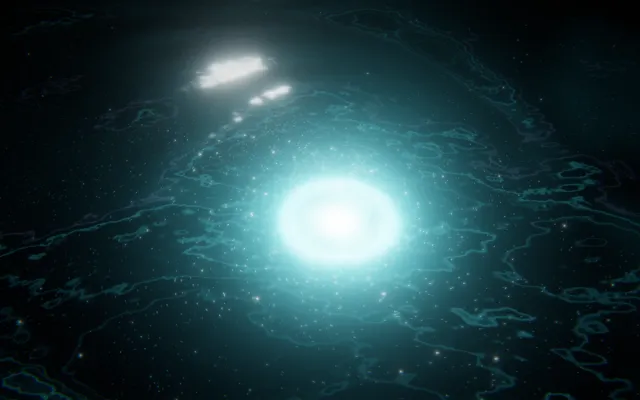
If immersion begins as a plunge into water, it seems right to end at a surface. Liquid Light is "a luminous surface with a memory for touch." Its page calls it "a dark mirror: a sheet of luminous water with height, flow and a memory of where you have been," and is careful to add: "It is not a picture of a sea. It is a surface that answers contact."
That answer is the point. Slide across it and currents linger in your wake. Hold in one place and the light charges there; release and a wave rolls across the sheet. With touch, you slide a finger to draw currents, rest it to charge a point and lift it to release the wave; with your hands, you point to stir and hold a pinch to charge the light. The wheel, two fingers, or an open or closed palm change how readily the surface answers. "A slow pass and a held point do different things," the page notes, "because the surface keeps answering after you leave." With sound on, it hums like quiet water: touch it and drops land in descending tones, and a held point gathers into a low note before the wave goes out.
Its suggestions for a first visit read almost like a lesson in Murray's sense: "Draw a slow path across the surface. Hold in one place and let the light gather. Release to send a wave outward. Cross an earlier trail before it disappears." None of it is a task. Each one teaches you a little more about how this water behaves, which is what learning to swim means.
So what makes a website immersive? Not the number of polygons, and not how much of the screen moves when you scroll. A page becomes a place when it answers you, keeps its own slow time, asks for nothing and lets you choose how much of it reaches you. Then a browser tab, for a while, stops feeling like a document and starts to feel like water you have stepped into. You can enter Synfield and try it for yourself.