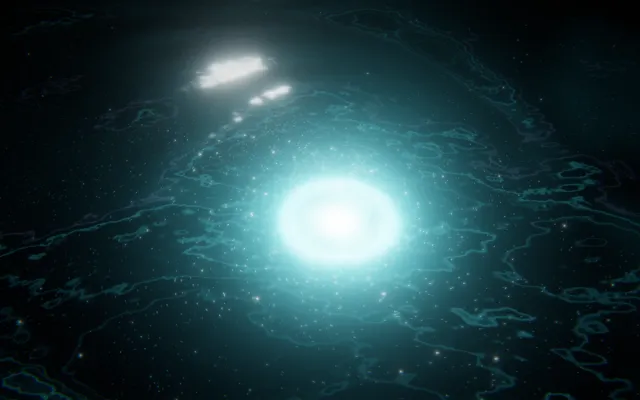
A surface that remembers
Liquid Light is a dark mirror: a sheet of luminous water with height, flow and a memory of where you have been.
Crests catch the light. Small points drift on it.
It is not a picture of a sea. It is a surface that answers contact.
What the surface keeps
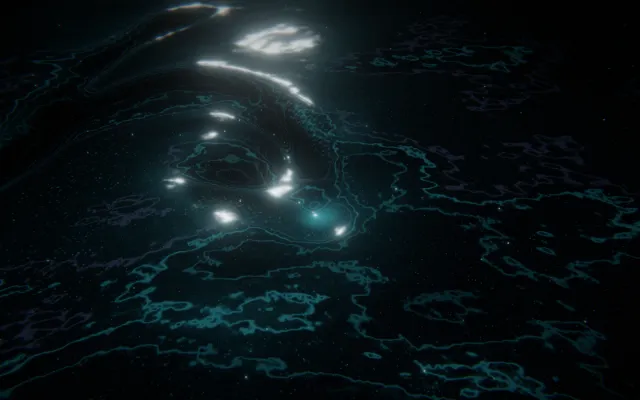
Slide across it and currents linger in your wake.
Hold in one place and the light charges there. Release and a wave rolls across the sheet.
A slow pass and a held point do different things, because the surface keeps answering after you leave.
Where it comes from
When a surface of water is disturbed, energy travels outward through waves.
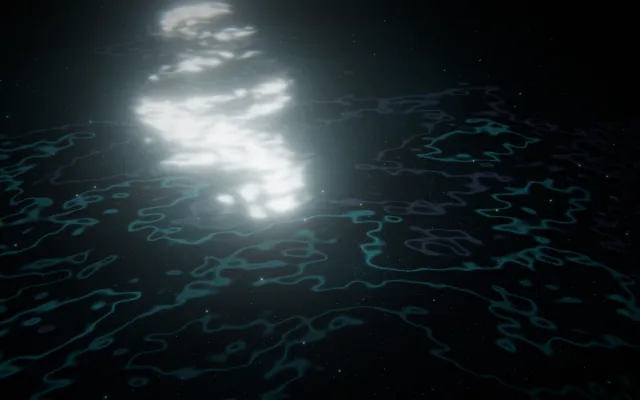
Ripples spread, cross one another and gradually lose their intensity, while currents carry movement through the surrounding liquid. The reflected light changes with every small variation in the surface, producing patterns that are never quite the same twice.
Liquid Light draws from these relationships between fluid motion, reflection and the temporary traces left by disturbance. It also connects with interactive light art, where a surface becomes something that can be played rather than simply observed.
Here, the water is imagined as light that remembers where it has been touched.
Things to try
- Draw a slow path across the surface.
- Hold in one place and let the light gather.
- Release to send a wave outward.
- Cross an earlier trail before it disappears.
With a mouse, touch or your hands
You can explore with a mouse, a touch screen or your own hands.
Mouse and keyboard
- Move to leave currents.
- Hold the button to charge a point, then release to send the wave.
- The wheel changes how readily the surface answers.
Touch
- Slide a finger to draw currents.
- Rest it to charge that point.
- Lift to release the wave.
- Two fingers change the surface’s response.
Hands, with the camera
- Point to stir and leave currents.
- Hold a pinch to charge the light, then separate your fingers to send the wave.
- Open or close the palm to change how the surface answers.